The Player to Pro (P2P) System · Digital edition
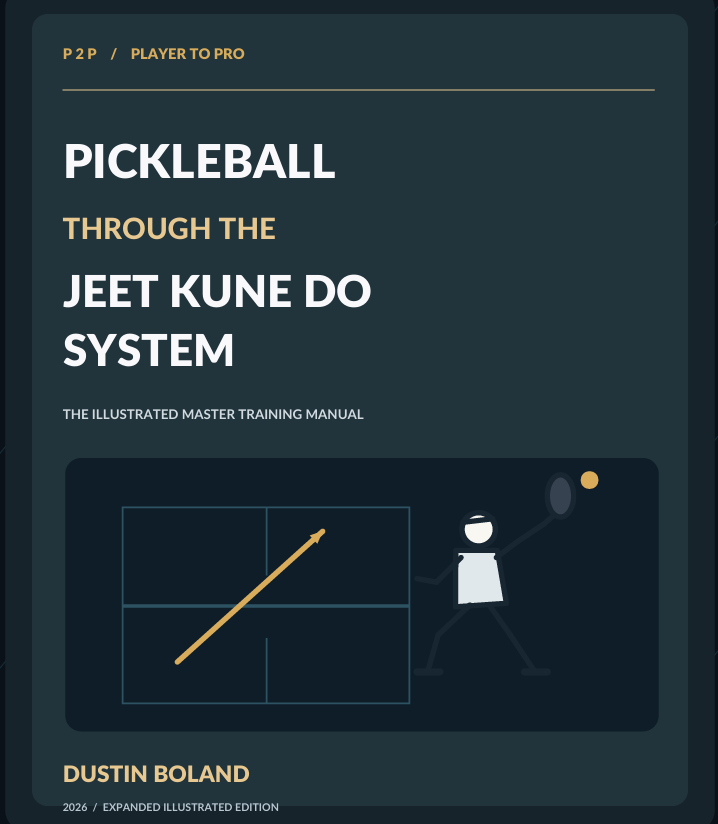
PICKLEBALL THROUGH THE JEET KUNE DO SYSTEM
A practical training manual blending the principles of interception, simplicity, timing and adaptability with modern pickleball. Includes original finger formations, named shot techniques, drills and a structured path toward your own playing style.
One-time purchase · Secure checkout hosted by Stripe. Digital delivery is enabled only after the PDF is stored privately and the purchase is verified.
The full PDF is never shown publicly. A verified paid Stripe purchase under your sign-in email is required for a temporary download link.
PLAYER2PRO · JEET KUNE DO INSPIRED TRAINING
THE PATH TO MASTERY
12 chapters. 12 progressive belt stages. From White Belt fundamentals to Red Belt mastery.
Expanded illustrated edition
SEE THE STRATEGY. MASTER THE MOVEMENT.
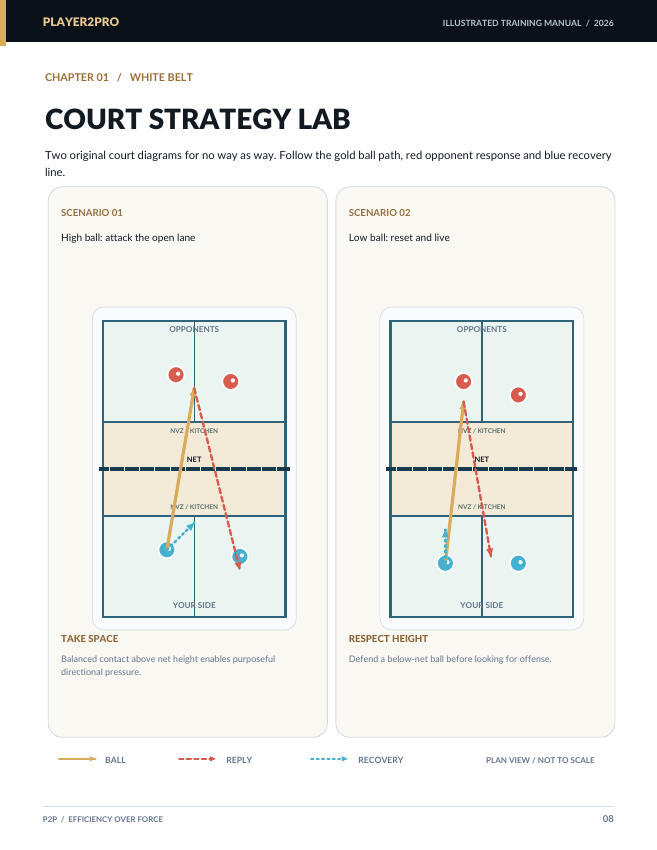
The expanded 67-page illustrated manual includes all 12 Player2Pro belt stages, original court strategy maps, movement studies, practice circuits, measurable progression tests and a tactical atlas.
Shown: an instructional sample page. The full PDF remains a private, payment-verified download.
Watch the philosophy in motion
PICKLEBALL THROUGH JEET KUNE DO
Explore the inspiration behind the Player2Pro approach to interception, adaptability and purposeful play.
Watch on YouTube ↗Inside the manual
12 CHAPTERS. ONE ADAPTIVE SYSTEM.
INTERCEPTION
Read the developing rally and take time away.
FINGER FORMATIONS
Five memorable grip-pressure and paddle-control modes.
STRIKING ARTS
Dragon Palm, Lightning Punch, Phoenix Kick, Tiger Claw and Snake Strike.
READ THE TRAINING OUTLINE
TABLE OF CONTENTS & TRAINING PREVIEW
01No Way as Way
Study fundamentals without becoming trapped by rigid patterns. Observe your opponent, court conditions, and the actual ball in front of you. Adapt technique to the rally rather than forcing a predetermined style.
Practice: Play three games with three intentions: patience, early interception, and directional placement. Journal what changes.
02Economy of Motion
Compact swings, early preparation, a balanced split step and a quick recovery reduce wasted time. The efficient strike is not necessarily the hardest strike.
Practice: Perform 30 cooperative dinks with minimal backswing, then 20 compact punch volleys.
03The Intercepting Paddle
Intercept a developing attack by recognizing preparation and meeting the ball early, while respecting the non-volley-zone rules. Choose a stable volley rather than a wild reach.
Practice: Partner feeds 30 controlled volleys; intercept at a comfortable distance and recover to ready position.
04Distance and Court Geometry
Baseline: serve, return and construct the approach. Transition: split step, reset and advance only on a manageable ball. Kitchen line: pressure with placement, patience and quick hands.
Practice: Start at baseline; execute a third-shot drop, split step in transition, reset, and advance after a quality ball. Repeat 15 times.
05Broken Rhythm and Deception
Vary speed, height, depth and placement with similar preparation. Deception must come from legal shot execution, not deliberate distractions.
Practice: From the same ready position, alternate a crosscourt dink, middle dink and controlled speed-up.
06Emotional Neutrality
Separate shot selection from frustration. After each point, release tension, assess the pattern and choose the next intention.
Practice: Begin practice games down 3–8. Track decisions, not only the final score.
07Five Ways of Attack
Single Direct Attack: attack a genuine opening. Attack by Combination: construct a sequence. Progressive Indirect Attack: draw coverage in one direction and play into another. Hand Immobilization Analogy: jam safely toward the opponent’s paddle-side hip or torso. Attack by Drawing: invite an attackable ball and counter.
Practice: Choose one attack pattern per game. Record successful setups and unforced errors.
08Personal Expression
Your physical capabilities, strengths and opponent reading should shape your game. Use a stable foundation, then refine what works through feedback.
Practice: Write your top three reliable shots and two vulnerabilities. Build a weekly drill around each vulnerability.
09Training Structure
Train footwork, balance, serves, returns, drops, resets, counters, tactical recognition and recovery. Alternate controlled repetitions with live decision-making.
Practice: 60-minute session: 10 warm-up, 15 touch, 15 transition, 10 counters, 10 constrained games.
10The Black Belt Mindset
Mastery is not a formal pickleball belt. It is consistent judgment, adaptability, composure and efficient movement under pressure.
Practice: After each match, document one smart choice, one costly choice and one adjustment.
11Finger Formation System
The five named formations are coaching metaphors, not official standardized grips. Hammer: secure, stable drive. Feather: relaxed touch for dinks and resets. Blade: face-angle control for slices and angles. Whip: relaxed preparation with controlled acceleration for rolls and speed-ups. Shield: stable compact block and counter. Avoid extreme grip tension and excessive wrist snapping.
Practice: Practice five balls per formation, focusing on paddle-face angle and repeatable contact.
12Named Striking Techniques
Dragon Palm: soft-looking preparation into a legal speed-up. Lightning Punch: compact punch volley. Phoenix Kick: defensive reset from transition. Tiger Claw: subtle finger-pressure adjustments for face control. Snake Strike: vary timing and direction while maintaining legal play. These are memorable teaching names, not literal martial-arts strikes.
Practice: Run a five-station circuit, one named technique per station, with a partner feeding controlled balls.
Training note
This is an independently developed pickleball teaching framework inspired by Jeet Kune Do concepts. It is not affiliated with or endorsed by Bruce Lee’s estate or any Jeet Kune Do organization. Consult current USA Pickleball rules for legal play. This page provides an educational preview; purchase confirmation occurs through Stripe. Digital-file delivery is handled separately from this page.