LESS WASTE
Keep retired balls in a dedicated material stream instead of assuming curbside acceptance.
PLAYER2PRO · CIRCULAR PICKLEBALL
THE LAST RALLY ISN'T THE END.
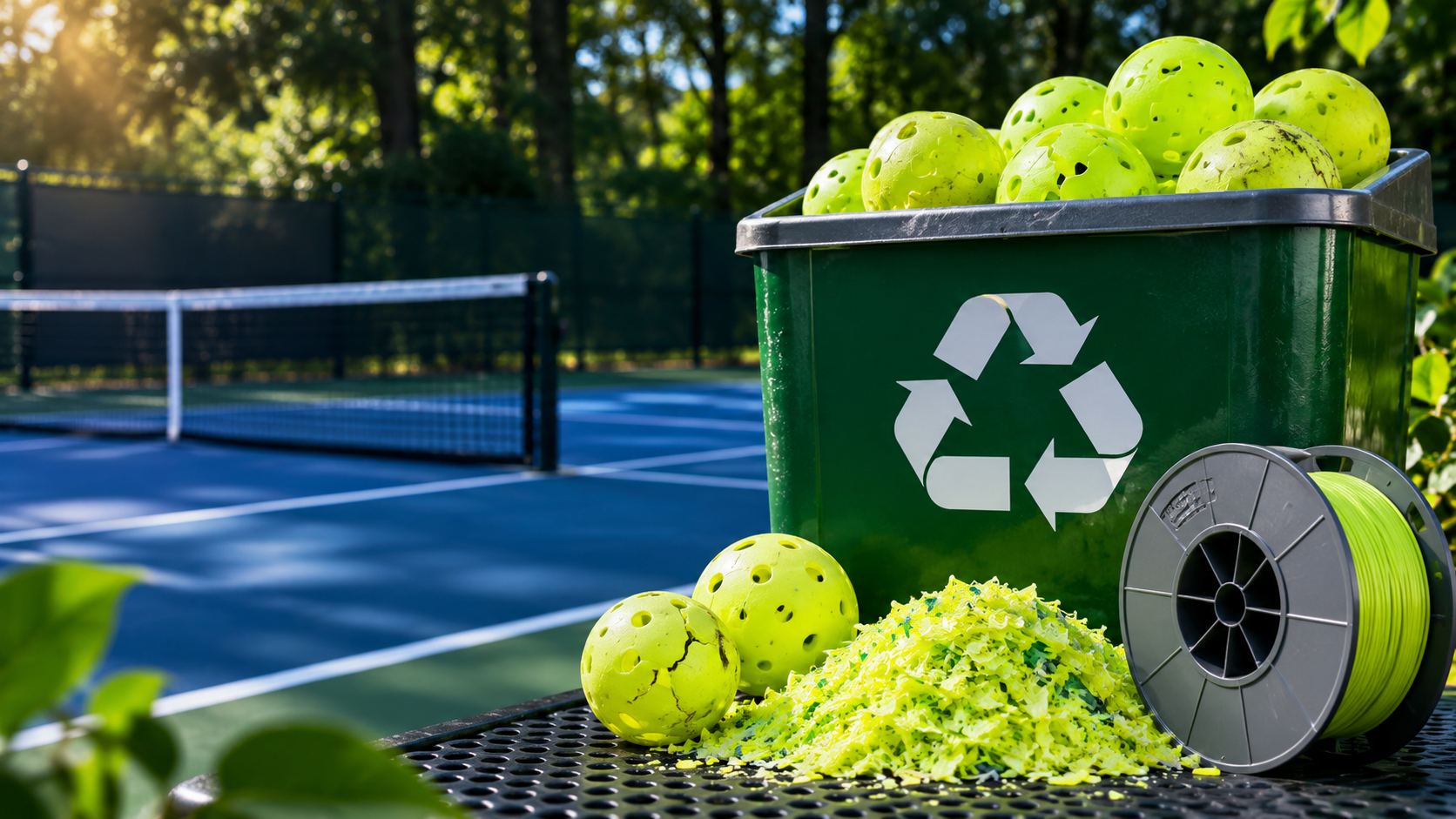
Give worn-out pickleballs another purpose. We're building a collection and materials-reuse pathway for community recycling, local STEM education, sustainable product concepts and responsible plastic reprocessing.
New program intake · Collection arrangements and manufacturing partnerships are coordinated case by case.
Keep retired balls in a dedicated material stream instead of assuming curbside acceptance.
Explore local STEM demonstrations, product engineering and school partnerships.
Test practical reuse pathways rather than promise unsupported recycling outcomes.
ONE BALL. MANY NEXT CHAPTERS.
Most pickleballs are made from polypropylene or polyethylene. They generally do not belong in household curbside recycling because of their shape, size and sorting requirements. Specialized collection and verified material processing may open useful pathways. Outcomes depend on the exact polymer, additives, contaminants and partners.
Sorted, cleaned and tested PP or PE plastic may be shredded and reprocessed into compatible extruded material. Potential uses include experimental 3D-printer filament, durable school models or workshops. Processing and printer compatibility must be verified first.
Pilot application
The recovered polymer may be suitable for blended film, reusable carrier products or molded handles when a qualified manufacturer verifies processing, composition, quality and product safety. Grocery bags are an exploratory destination, not a guaranteed output.
Processing partner required
Partner with local STEM educators for material-identification, sorting, circular-economy experiments and design challenges using cleaned, safe samples. Shredding and extrusion require supervised equipment and safety controls.
Community education
Compatible regrind could become non-food-contact clips, trays, organizers, plant pots, storage accessories or practice-court hardware following polymer characterization and manufacturing tests.
Prototype opportunity
Investigate durable recycled-plastic markers, plant labels, garden edging, small outdoor organizers and other low-risk applications that can tolerate varied recycled material.
Prototype opportunity
Intact retired balls may serve in supervised art displays, classroom geometry, decorative projects or skill demonstrations. Damaged pieces must be kept away from small children and animals.
Reuse before reprocessing
Example use cases are concepts to evaluate—not claims that Player2Pro currently manufactures these products, operates an extrusion line, or has agreements with local schools.
FROM COURT TO CIRCULAR ECONOMY
Tell us how many worn or cracked pickleballs you have and your ZIP code.
We review local handoff options. Do not ship or leave materials anywhere until a location and process are confirmed.
When accepted and physically received, materials can be counted and separated by plastic type, condition and contamination.
Coordinate with approved recyclers, makers, manufacturers or educators where feasible. Reuse and processing depend on verified partners.
RECORDS & RESPONSIBILITY
Potentially, but not simply because materials were recycled. A federal charitable deduction for donated property generally requires a qualifying charitable recipient, an eligible donor, appropriate documentation and a supportable value. Player2Pro's recycling intake program is not represented as a qualified tax-exempt charity. Submitting this form or handing over materials does not itself create a tax deduction.
If a future project operates through an IRS-qualified charitable partner, the qualified organization—not this intake form—would need to issue any required acknowledgement. Donors are responsible for valuation and filing; used cracked balls may have little or no fair market value. For tax decisions, consult a qualified tax adviser.
Verify a charity with the IRS$250 or more: A contemporaneous written acknowledgement is generally required for charitable contributions at that level.
Over $500: IRS Form 8283 is generally required for noncash charitable deductions.
Over $5,000: A qualified appraisal is generally required, with exceptions.
Illustrative U.S. federal rules, subject to exceptions and current law. No SSN, EIN, payment details or estimated dollar deduction is collected by this form.
JOIN THE RECYCLE PROGRAM
Have a bucket of cracked or worn pickleballs? Register your interest and we’ll review potential collection or drop-off coordination. Clubs, parks, schools and tournament organizers can submit larger quantities.
The intake record is restricted to program administrators. Details are used to review your request and contact you about material handoff. This form never requests tax identification numbers or payment.